

As the dust settles on the regional qualifiers and the 16 teams pack their bags for Malmö this October, the global rankings are a right mess. We have the Big Three sitting in their statistical ivory tower, a massive 1,000 point vacuum beneath them, and a crop of regional champions flying to Sweden with literally zero global maths to their name.
From an official algorithm POV, Champs looks like a seeding disaster waiting to happen. How do you map a bracket when 3 of the teams are completely uncalibrated? Will we be throwing tourists to the titans?
Who’s Packing for Sweden?
Just in case you didn’t quite keep track across those 7 tournament weekends, here are the 16 leagues that have officially punched their tickets to Malmö:
Latin America: 2×4 Osom
North America West: Denver Roller Derby, Rose City Wheels of Justice (WoJ), Santa Cruz Derby Groms, Rose City Axles of Annihilation (AoA)
North America South: Black Derby Collective (BDC), RipTide Roller Derby
North America Northeast + Canada: Arch Rival Roller Derby, Gotham Roller Derby, Calgary Roller Derby
Europe: Roller Derby Toulouse, Rainy City Roller Derby, Paris All Stars, Crime City Roller Derby
Oceania: Victorian Roller Derby League, Adelaide Roller Derby
(And, yes, under current WFTDA Charter Policies, two teams from the same league can totally compete at Champs at the same time. Provided they stick to that strict 3-skater postseason crossover limit. Rose City’s double bid is real.)
Anyway, this month we’ve discovered boys can play football too, so if you, like us, have been watching the Men’s Football World Cup this month, you are experiencing the absolute joy and jeopardy of knockout tournaments. We are watching traditional titans (Tchau Brazil! Au revoir France!) fall while teams rewrite the script. In our sport, WFTDA sacrifices ranking perfection to ensure global inclusivity, mimicking that World Cup model.
How did they qualify?
The path to Malmö was dictated by WFTDA’s shift to a regional quota system, a deliberate move designed to ensure global representation and lower the financial barriers of international travel. But despite best intentions, this structure has created its own geographic quirks.
Take Calgary Roller Derby as the prime example: despite being geographically aligned with the stacked North America West region, they chose to qualify out of the North America Northeast + Canada bracket instead. This shuffling guaranteed some high stakes but exposed how rigid regional boundaries can become when sorting global talent, and navigating treacherous political waters.
Knockout Derby is ruthless by design. You can be elite on paper, but if you drop a single jam at the wrong time in a regional quarterfinal or semifinal, your season is over. And that’s the beauty, and devastation of tournament play. We lost some serious juggernauts to regional eliminations, who will now be watching from home instead. As we saw during postseason, getting a tournament bye can leave a team coming into a quarterfinal game cold. And even Titans get nervous when it’s all on the line.
Quarterfinal upsets…
❌ Angel City Hollywood Scarlets
❌ California Derby Galaxy Supernovas
Semi-Final upsets were trending too…
❌ Texas Rollergirls Texecutioners
❌ Red Stick All Stars
❌ Brisbane Punk Rockers
❌ Minnesota Roller Derby
Two upsets in the finals but only one cost a team its place at Champs
❌ Montreal Roller Derby
Step Into the CPC’s Shoes
The Competitive Play Committee (CPC) are the folks behind the curtain, the ones responsible for wrangling the rankings and mapping out the tournament structures.
As you read this, the CPC is currently working on the bracket for Champs. Once they’ve slotted teams in they’ll have a chance to request changes before the bracket will be released later this month. They are staring down a nightmare scenario, and spoiler alert: the maths they have to work with is properly broken.
But before breaking down why the maths is, well, complicated, try it out yourself. We’ve built an interactive Malmö Bracket Simulator. Try to place the 16 locked-in teams into a fair day one gauntlet without creating a blowout.
1. Select a Team to Place in Round 1
How did you do? Manage the impossible? Speculation, yours and ours, is all we have right now, so let’s take a look at what we do know and then check all the angles.
Confirmed so far, WFTDA has scheduled Malmö as a 4-day tournament. A standard 16-team, single-elimination knockout bracket only requires four rounds of play. So, why do we need four full days of track time?
2 Major Reasons
First, minimum game guarantees. If Champs was a single-elimination knockout, the 8 teams that lose in round one would be gone after just a 60 minute game. Asking a league to fundraise to travel from Latin America or Oceania to Sweden for 1 hour of track time is financially unviable, to put it politely.
Second, throwing an uncalibrated regional qualifier directly into the path of a top 4 team early on is a recipe for a battering that serves nobody. To fill the 4-day footprint and keep Champs competitive, the CPC has a few options on the table.
They could use a World Cup Model (Pool Play). Group stages on Thursday and Friday, leading into a weekend knockout. This would also guarantee every team at least three games, while allowing the action on the track to fix any seeding errors before the elimination rounds begin.
Now, the more I think about this one, the more I like it. CPC could try a Radical Split (Hydra vs. Challenger Shield). A sudden-death sorting round on day one. 8 winners enter the elite Hydra bracket; 8 losers enter a parallel Challenger tournament. By day two, the field is perfectly self-calibrated, ensuring tight, fierce competitive games across the board.
One more option that the CPC could use takes into account their vast knowledge, experience, and purpose for existing. They might do the good old ‘Eye Test’ Knockout. Pretty much they’d force a traditional 16-team bracket. But because the regional maths is all over the shop, they abandon the spreadsheets entirely. Just a committee manually voting on the seeds, based on subjective human calibration. Danger? Human bias and the very real risk of getting the matchups completely wrong on that all-important first day.
Regional rankings don’t offer much help when it comes to seeding for Champs, but there is a single global ranking system that does exist in Roller Derby.
ENTER GUR
Regardless of what the CPC chooses, they still have to actually seed these 16 teams, AND they’ve indicated that they won’t be using GUR in this cycle. But what is it? The acronym GUR (Geographically Unrestricted Region) gets thrown around a lot, but don’t worry, the GPA that sets the global ranking functions exactly the same way as the GPA that sets regional ranking.
Your Game Points = Opponent’s GUR Score × (Your Points / Their Points)
Now, here’s the thing, there’s a catch. It’s all about who you are allowed to apply that formula against. To get a GUR ranking, a team must play at least one extra-regional game within a rolling two-year window.
Historically, global rankings decided exactly who went to Playoffs. But since 2024 WFTDA shifted to a strict regional quota system to lower travel barriers. Champs invites were handed out based on geographic tournament finishes.
So who uses GUR? Independent tournament organisers booking high-level, cross-continental action can use it to select and seed their brackets. It allows calibration for regional outliners (like Victorian or 2×4 Osom) to track their progress globally. And one of our favourite reasons, Bragging Rights. Claiming you are the #1 globally ranked team in the world holds massive marketing weight. It is the ultimate currency for sponsorships and recruitment. Plus, sounds pretty damn cool, no?
Please Mind the Gap
When you line up the 16 teams travelling to Malmö against the actual GUR Top 16, a few things seem amiss. Look at Angel City Hollywood Scarlets. They hold a massive 1,352.75 GUR, making them the #4 globally-ranked team in the world. They’re not going to Champs; A cold start in the California quarterfinal spelt chaos and disaster, meaning our LA stars were forced to take a hike.
When we say ‘Mind the Gap’, we mean it. Let’s take a look at where all of our Champs (and non-Champs) teams fall along the (super long) GUR scale…

Remember all those scrolls ago, you were in the rarefied and isolated stratosphere of the Big Three:
Rose City WoJ: 3,260.64 GUR
Arch Rival: 3,183.53 GUR
Denver MHC: 2,289.73 GUR
And then… Nothing. No-one. For days. A desert. Why? Where is everyone?
Answer: everyone else is under 1400 GUR.
Point-exchange algorithms are fundamentally vulnerable to hoarding at the very top. Top teams play each other deep in the bracket, trading massive algorithm points. If they don’t play teams in the mid-tier range frequently enough, those mid-tier teams never get a chance to siphon points upward. All of this begs a question we just can’t help but ask.
How different is the Champs 16 to the GUR top 16?


Looking at those two lists side-by-side, the problem isn’t just that top-tier juggernauts like Angel City or Montreal are missing out due to the cruelty of single-elimination regional qualifiers.
The proper headache for the bracket makers is that the right-hand column features a massive, uncalibrated blind spot. Under the current rules, Paris, BDC, and RipTide are statistical ghosts on the global stage. Trying to force a traditional knockout bracket right now is like throwing darts in the dark.
Brackets & Bridges
Now, let’s say we wanted to try to find a way to seed the Champs 16, and maybe give ourselves a sneaky idea of how the bracket could play out…
First problem? Uncalibrated teams. Unknowns. How to place them?
We didn’t want to reinvent the wheel or mess with WFTDA’s core algorithm, but we did want to use GUR. So, we kept everything exactly the same, the rolling 24-month window, the standard point weightings, the whole kit and caboodle.
We made exactly one change: we opened the border. We allowed standard regional games played against opponents who already hold a GUR to act as a bridge, calculating a global ranking for teams that haven’t crossed an ocean yet.
When using this exact bridge-only model to integrate the uncalibrated qualifiers flying to Sweden into the official WFTDA leaderboard, the tournament seeds would line up like this:
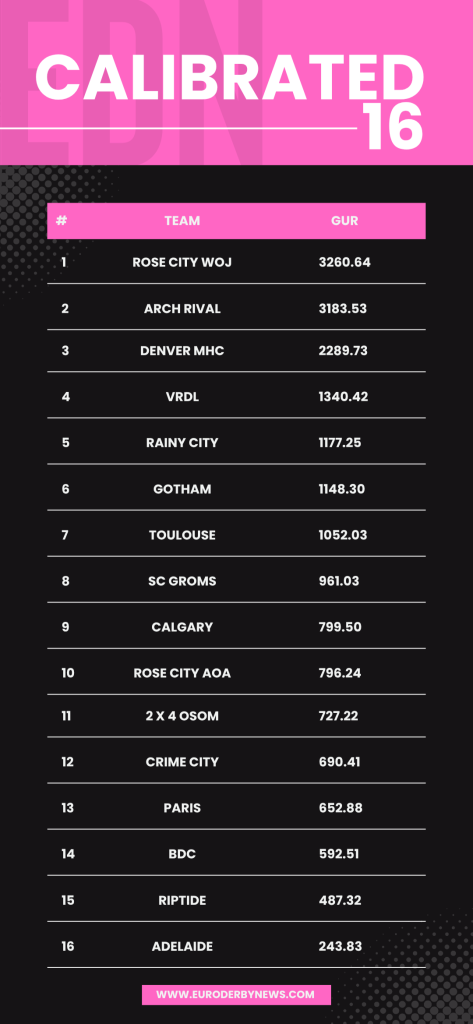
Showing Our Working
Here is exactly how that Regional Integration maths calculates out using the official WFTDA formula:
Calibrated GUR = (Opponent GUR) × (Your Points / Their Points)
We ran the regional scores for the unranked teams through this exact formula against their GUR-holding opponents to find their place in the global rankings:
Paris All Stars: When you take their scores against Toulouse (Official GUR: 1052.03) and Crime City (Official GUR: 690.41) and run the point ratios through the formula against their opponents’ official baselines, their averaged Calibrated GUR lands at 652.88.
Black Derby Collective (BDC): Running their recent upset scoreline against Texas through the formula against Texas’s official baseline yields a Calibrated GUR of 592.51.
RipTide: Taking their victories against Red Stick A and Tampa Tantrums and running the point ratios through the formula against their opponents’ official baselines yields an averaged Calibrated GUR of 487.32.
By using the data that already exists within the regional bubbles, we can bypass the uncalibrated blind spot. No radical rule changes required – just a simple bridge to give every team the global ranking they’ve earned.
Now we’ve got into this before, but there are two schools of thought here. Some will argue that any team going to Champs already can, and really should, take part in an extra-regional tournament in the same year as Champs. When looking at it from this perspective, travel isn’t a hardship; it’s a requirement for a team playing at a global level to be accurately seeded. And, let’s be honest, the moment GUR becomes the definitive way to do it, the competitive season would immediately morph to accommodate GUR tournaments.
On the other hand, WFTDA explicitly chose geography over greatness this cycle, specifically to continue regional representation development AND to rebuild the competitive framework. What happens next is TBD and WFTDA members are in control of that future structure for 2028 and 2030. WFTDA league skater? Speak to your rep.
Anyway, if we’re out here waving magic wands around willy-nilly, why not both? What if 12 teams qualify from regionals and 4 additional GUR wildcards are added?
Maybe we can have our cake AND eat it too!
FINAL SORT
The CPC has an impossible job on its hands to seed this upcoming Champs bracket. Stats tell us the field is messy, meaning the committee are staring down a right headache that would probably make anyone else run for the hills. Whatever approach these folks use to decide how to map out or seed those 16 spots, be it the safety of pools, a radical split, or a traditional knockout, it is going to cause conversation, and perhaps some chaos. But maybe that’s the point.
Not one of us does this for the spreadsheets (ok, maybe 2 of you do). It’s all about seeing the culmination of two years of blood, sweat, and sacrifice. We are watching skaters who have mortgaged their holidays, their savings, and their weekends to prove that their league belongs on the global stage.
As a top-seeded juggernaut or an uncalibrated underdog from halfway across the world, when that whistle blows on Thursday morning in Malmö, the rankings disappear. Algorithms vanish. Ten skaters on the track and the cold, hard reality of the jam line.
And that’s the beauty, and the devastating cruelty, of tournaments. So the bracket might be messy, the maths might be broken, and the seeding might be a nightmare – but the spectacle, the theatre? Oh, that is going to be perfect.
October cannot come fast enough.
Subscribe to our free newsletter now to get Euro Derby News delivered straight to your inbox all season long.
It’s probably not allowed under the WFTDA policy, but I think the 30 minute seeding games in the Men’s RDWC worked a lot better then expected. You can make 4 groups of 4 teams based on (bridged) GUR, 3 games for each team. In Orléans, it sorted out the regional anomalies and false predictions. Top half goes to bracket play, bottom half gets 2 games for ranking.
Disclaimer: I did not check if needed track time matches available track time, or any other actual physical constraint.