Category: BIG Reads

The BIG Read: Geography vs. Greatness

We’ve been watching the WFTDA Latin America Championships this weekend, and what a weekend of derby it was!

Congratulations to the new Latin America Champs – 2 x 4 Osom!

Seeing the Bogotá Bone Breakers battle their way from the very first round all the way to the final reminded us exactly why playoff season is the most brutal, beautiful time of the year. Leave it all on the track kind of derby that has us looking ahead to Champs in Malmö and saying the quiet part out loud…will this new playoff system actually let the best teams in the world compete for the Hydra?

Because looking good on a WFTDA spreadsheet doesn’t mean a thing when you’re lining up against a top tier tripod. But before we start tearing apart the GRR and GUR rankings to prove it, we need to talk about why these brackets are so warped in the first place: the massive, self-funded price tag required to even exist in global Roller Derby.

Money vs Maths

Pre-2020, WFTDA playoffs were purely based on global rankings. If you were in the top 40 globally, you went to a global playoff. While this was mathematically pure, it was a logistical and financial nightmare. Expecting a team from Australia, Europe or Latin America to raise tens of thousands of dollars/euros/pounds/kronor to fly to the USA for a Playoff weekend, and then fly back to the USA a month later if they qualified for Champs, was simply unsustainable.

Following the pandemic, WFTDA rightly recognised that the sport needed to recover. The Regional Competitive System, launched in 2023, has a noble goal at its heart – lower the barrier to entry, cut down on prohibitive travel costs, and guarantee that every region around the world gets representation at the highest level of the sport. By regionalising the playoffs, teams only have to travel within their own region to qualify for Champs.

Now, let’s be honest, we all share the same goal: to watch incredibly high-level roller derby while actively investing in the long-term future and accessibility of the sport worldwide.

But here’s the rub…where the noble intention clashes with the mathematical reality. In solving a massive financial and accessibility problem, WFTDA created a system where geography fundamentally takes precedence over actual global gameplay levels.

So, notebooks out. We’re going to break down how the brackets might come together, where the friction lies, and if there is an ideal system out there that balances the map, the money and the maths.

Decoding – GRR vs. GUR

First up, we need to talk about the two different sets of numbers running the show: the GRR and the GUR.

GRR (Geographic Regional Rankings): Exactly what it sounds like. It calculates how you stack up against the teams in your specific geographic region. The catch? It only takes into account games played against other teams within your same region. It’s a closed-loop system.

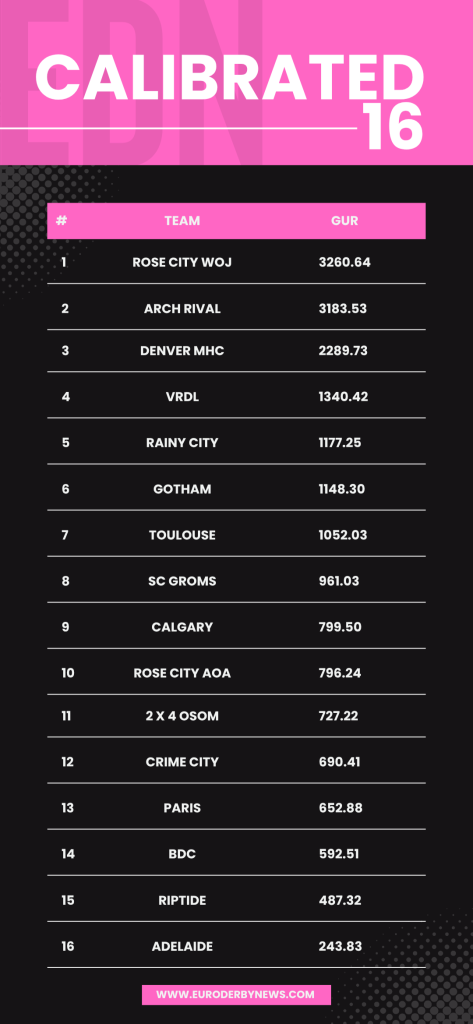
GUR (Geographically Unrestricted Region): Despite the clunky name, the GUR is essentially WFTDA’s global ranking. It calculates where teams stand worldwide. However, to get a GUR ranking, your team has to play at least one extra-regional game (a game against a team from a different region) within a rolling two-year window.

VIP note on GPA: Before we get into it, we need to issue a quick disclaimer! You absolutely cannot compare the Game Point Average (GPA) of a team in the GRR with the GPA of a team in the GUR. They might use the same maths but they’re calculating performance against entirely different, isolated pools of opponents. Any direct comparison between a regional GRR GPA and a global GUR GPA is mathematically useless.

Got no GUR?

Say a team hasn’t played another team outside of their region in the last two years, then they simply don’t exist on the global (GUR) leaderboard. They’re completely uncalibrated against the rest of the world and live entirely in their own regional bubble.

Back to that friction we mentioned…because the 2026 Champs invites are handed out based purely on region, a team with no GUR can still secure an invite to Playoffs and Champs. Meaning, if they’ve only played teams in their own back garden, they get a pass.

Guessing the Invites

We know that the 2026 Global Championships in Malmö will be a 16 team tournament, up 3 more teams than 2024. We’re also pretty sure that every WFTDA region is guaranteed at least one participating team. What we absolutely don’t know yet is how the WFTDA will slice up that 16 team pie across the seven playoff tournaments. We’ll have to wait and see what the Calibration Committee serves up.

But, looking back at recent years and weighing current global strengths, here is our educated guess for how those 16 invites will likely be allocated under the current structure:

NA West: 3 invites

NA Northeast: 4 invites (split over 2 playoffs)

Europe: 3 invites

Oceania: 2 invites

NA South: 3 invites

Latin America: 1 invite

If this allocation holds true, the regional maths becomes incredibly difficult for some, while offering a relatively smoother path to others.

Surviving the Group of Death: NA West

Assuming the West gets 3 invites, the region is currently so packed with top tier talent that it’s practically a bloodbath. Teams like regionally ranked #4 Groms: Legacy A are also ranked in the Top 16 globally on the GUR. Because the West will likely only have those strictly limited 3 invites, world class teams are going to be forced to eliminate each other just to advance. Statistically, it is highly likely that multiple Top 16 global teams will miss out on Champs because their region is simply too crowded.

“The maths proves that a fourth or fifth place finisher in these regions meets that global standard; they are top class, completely capable of holding their own against the best on the planet.”

No Deep End: NA Northeast

On the flip side, we have the NA Northeast. Splitting the Northeast into a Canadian tournament and a US Northeast tournament means they will need 12 teams each. While the Northeast certainly has absolute powerhouses at the top (like Arch Rival and Montreal), they’ll likely have to dip much further down the regional rankings just to fill out the brackets. Because of this lack of overall depth compared to the West, lower ranked teams in the Northeast have a significantly different path to competing for those expected invites.

High Ranking Hosts: Europe

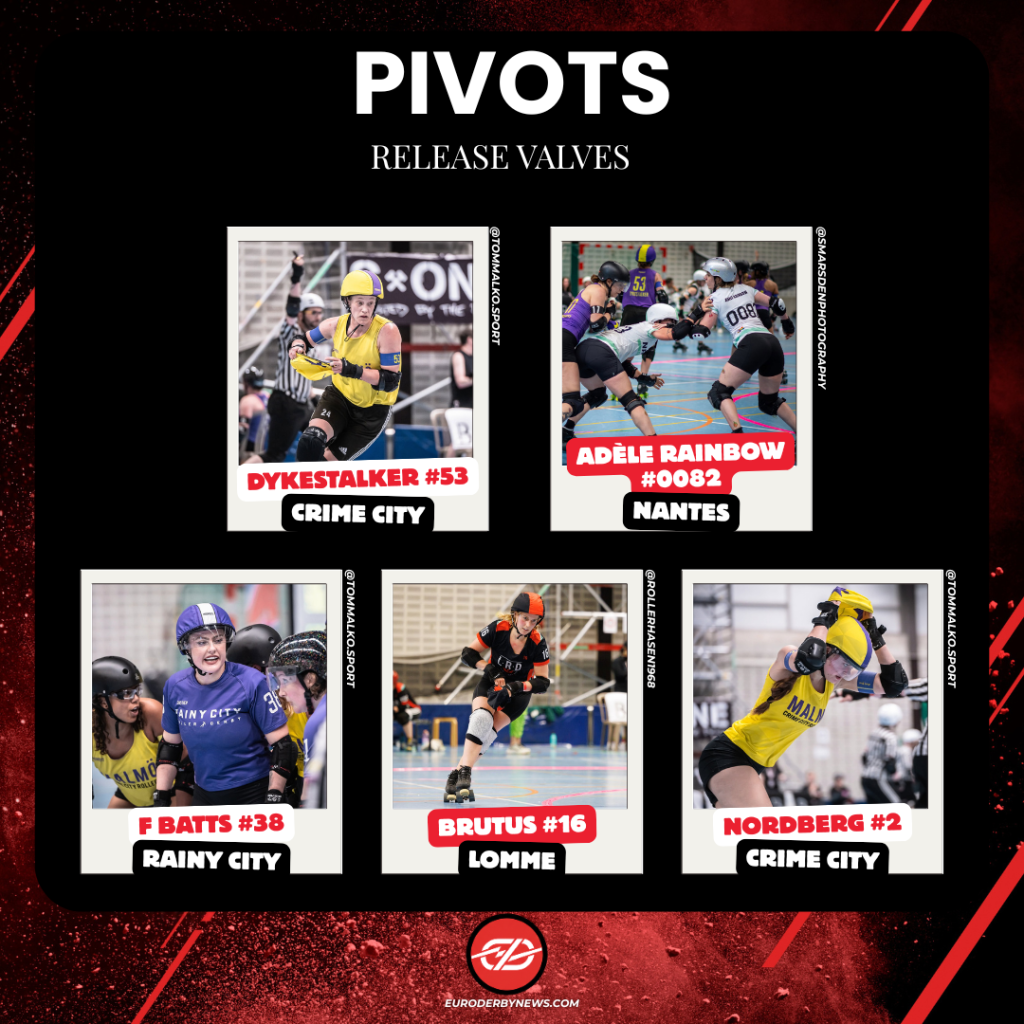
For those of us in Europe, the maths is incredibly tight. Fan favourite teams like Crime City, Nantes, and London Brawling are sitting right on the bubble, fighting for, what we guess, will be 3 spots. And it gets even messier when you consider the unique case of the Paris All Stars. Currently, Paris is missing from the global GUR because they haven’t played that extra-regional game. Living their best life entirely in their own highly successful regional bubble. But, and it’s a big but, they are still a top seed in Europe.

This makes them the only top seed at any playoff tournament without a GUR. And because they are extremely likely to claim one of those limited European spots at Champs, this mathematical quirk creates an oddity: a team completely uncalibrated against the rest of the world is almost certain to push out another European team that holds a legitimate Top 16 global ranking. But we can’t punish a team for dominating the track in front of them without bankrupting themselves on international flights.

Bridging the Gap: NA South & Oceania

Roller Derby’s developmental gap is most visible in the NA South and Oceania regions. While Latin America’s 2×4 is undeniably a strong contender globally, the top teams from NA South proper often rank lower on the GUR. If Oceania teams secure those 2 invites, it further pushes out mathematically stronger North American or European teams to fill out that 16 team bracket.

“When the global skill gap on the track is simply too wide, the result isn’t a compelling underdog story; it’s a blowout.”

Competitive Champs

While guaranteeing geographical representation is a noble goal for the post-pandemic era, the WFTDA Calibration Committee is staring down another, equally pressing priority – preventing massive, uncompetitive blowouts on the global stage.

Making decisions like where to allocate the new, extra invites for Malmö’s expanded 16 team bracket, the powers-that-be aren’t just looking at who takes home the regional gold. There’s close examination of the GPA spreads within each region. Specifically? Looking at the gap between a region’s number one team and their number four or five team. The WFTDA will be considering these specific spreads to ensure that a region’s depth is genuinely up to a global standard before handing them additional tickets to Sweden.

In the exceptionally deep talent pools in NA West and Europe, the GPA spread is real tight. The maths proves that a fourth or fifth place finisher in these regions meets that global standard; they are top class, completely capable of holding their own against the best on the planet. In other regions, however, the GPA spread tells a different story, and the skill drop off after the top seed or two can be dramatic.

Another collision point…Maths vs the reality of the sport as a spectator event. We all saw what happened at the 2024 Championships. When the global skill gap on the track is simply too wide, the result isn’t a compelling underdog story; it’s a blowout. No one, not the skaters spending thousands to be there, not the officials, and certainly not the fans tuning in around the world, wants to see massive, demoralising point differentials on the sport’s biggest stage.

The only way to ensure a truly competitive Champs is if WFTDA acts strategically. Funnelling those extra invites to the regions with the tightest GPA spreads isn’t just a nod to statistical greatness; it’s a necessary safeguard. To have a tournament in Sweden where every single jam is a battle of equals, the math dictates that those extra invites have to go to the regions whose deep rosters definitively meet the global standard: NA West and Europe.

Every Fix Has a Flaw

This got us wondering: if the current regional system artificially restricts the deepest talent pools to satisfy geographic quotas, and requires a level of strategic assistance from the WFTDA… how do we fix it? Should we fix it? What does an ideal system look like? Is there an ideal system?

Uncomfortable truth time. The perfect system/bracket does not exist. Every structural solution forces us to choose between mathematical accuracy, financial viability, and global inclusion. Let’s look at the options on the table, and the massive catch that comes with each one.

Option 1: Math Utopia (Pure GUR / Wildcards)

What if we guarantee one invite for every regional champion (to ensure global representation), and then hand out the remaining spots as Wildcards purely based on the Global Rankings (GUR)?

Result: The NA West’s “bloodbath” is averted as their top teams easily secure spots. Europe gets a boost.

Catch: It’s a wealth test. Do you know how you get a high GUR ranking? You play extra-regional games. Do you know how you play extra-regional games? You have the money to travel. Handing out wildcards based on the GUR just guarantees that the wealthiest teams who can afford to constantly fly around to inflate their global strength factor get to hoard the spots. It turns the postseason into a financial arms race.

Option 2: Coefficient System (UEFA Model)

Instead of relying on regular season algorithms, WFTDA could base regional invites on how teams actually perform at Champs. Every region gets a baseline number of invites, but if the NA West sends 3 teams to Malmö and they all finish in the top 5, the West earns a 4th invite for their region in the next cycle.

Result: It completely removes the wealth factor of the regular season. Regions earn their invites on the track at the World Championship, not with their travel budgets.

Catch: Derby moves too fast. Unlike professional football, grassroots roller derby rosters experience massive turnover year-to-year. A coefficient system punishes or rewards the skaters of 2026 for what retired skaters did in 2024. It is too slow to adapt to the reality of self-funded skaters.

Option 3: Day One “Repêchage” (Play-In Tournament)

If we can’t agree on who the 16th best team is on a spreadsheet, let them fight for it. WFTDA could hand out 14 guaranteed regional invites, and then invite the 4 highest ranked bubble teams to Malmö a day early for a Play-In tournament. Win, and you enter the main bracket.

Result: Purest distillation of “prove it on the track.” No algorithms, just Roller Derby.

Catch: It is financially AND emotionally devastating. Asking a self-funded team from Colombia or Australia to fundraise thousands of dollars to fly across the world to Sweden for a chance to play in the main tournament, only to potentially be eliminated on a Wednesday morning after one game, is cruel. (As anyone with a background in martial arts will tell you.)

Option 4: Status Quo (Strict Regional Quotas)

Which brings us right back to the system we currently have. WFTDA assigns strict regional invites based on geography to guarantee that developing regions have a secure seat at the table.

Result: Travel costs are lowered, the barrier to entry is accessible, and the sport grows in Latin America and Oceania.

Catch: World class teams are left at home. Top 16 global teams in the NA West and Europe will eliminate each other in their regional playoffs, meaning statistical greatness is no longer enough to earn a spot at World Champs.

No Magic Wand

When you look at the options laid out side-by-side, it becomes clear that the WFTDA is operating in a landscape of impossible choices. You can’t fix the maths without breaking the bank, and you can’t protect the bank without breaking the maths.

Tricky Travel & RSVP’s

Even with all this mapped out, the reality of 2026 remains fluid. Invites for the postseason have only just been sent out. On top of the ranking chaos, there are massive travel and visa issues to navigate this year. To prevent teams from having to unnecessarily leave or enter the USA, WFTDA is strategically inviting teams to specific North American Playoffs (Lansing, Michigan or Waterloo, Ontario). A logistical move that guarantees qualifying North American teams can attend a postseason event without facing hardship due to current US passport and immigration policies.

Our 30,000-Foot View

This year’s Champs in Malmö is built on a devastating trade-off. Even with the Calibration Committee funneling extra invites to the deepest regions, it isn’t enough. WFTDA is still mathematically sacrificing top teams from NA West and Europe, leaving world class skaters to watch from the stands. The derby played in Sweden will still be fiercely contested, but we can’t pretend the current system is fair. Writing off the heartbreak of these eliminated teams as ‘growing pains’ ignores the thousands of dollars/euros/pounds/kronor and endless hours they sacrificed for a shot they never truly had.

​We must keep having these difficult, messy conversations about how we balance global inclusion with elite competition. Because while geography might dictate who gets a ticket to Sweden this year, the undeniable reality of who actually dominates on the track remains, and the teams pushing those boundaries deserve a system that will eventually reward them for it.

Leave a comment

Instagram: @euroderbynews Hit follow for live score reactions, upset alerts, and on-the-ground updates as the maths unfolds in real-time.

Subscribe now

Subscribe to our Substack: Playoffs might be geographically restricted, but our postseason coverage isn’t. From tracking the GUR to scouting the global competition heading for Europe, we’re crunching the numbers all season long. Subscribe to get Euro Derby News delivered direct to your inbox!
Share


The BIG Read – European Roller Derby Architecture

EDITOR’S NOTE:

We missed the mark with the initial framing of this piece. By focusing on official federation claims, we inadvertently prioritised a “high-performance” narrative that doesn’t reflect the reality of the sport in the Czech Republic.

After hearing from the community, it’s clear that despite any official status, the Czech National Team remains entirely self-funded and volunteer-led. We regret entering an institutional narrative that obscures the DIY labour and financial sacrifice of the skaters.

The success of Czech Roller Derby belongs to the skaters, not the suits.

If you would like to support the Czech National Team directly, you can reach out to them regarding sponsorship or material assistance:

We have kept the original text below as a record of the federation’s public positioning, but we encourage our readers to support the skaters and supporters who truly power this sport.

ORIGINAL ARTICLE

The international Roller Derby landscape has shifted significantly. Following the 2024 WFTDA World Championships, Europe has evolved from a mere participant into the strategic heart of the sport.

As the “Road to Malmö” begins for the 2026 WFTDA World Championships in Sweden, the continent’s rise is fuelled by the development of national leagues and unprecedented government support. To fully understand this new and emerging era, we must first understand the underlying machinery and architecture.

The WFTDA Competitive Cycle

The Women’s Flat Track Derby Association (WFTDA), the international governing body for Women’s Roller Derby, currently uses a two-year competitive cycle. This replaces a previous annual schedule and provides teams with more time to plan international travel and local development. However, it also means that every match influences a team’s position in a standings table tracked over two years.

Global Regions and the GUR Exception

Under this system, the world is divided into six geographic regions. These are Europe, Oceania (Australia, New Zealand, and nearby areas), Latin America, and three North American divisions. However, top leagues often schedule matches across borders under a unique seventh system called the Geographically Unrestricted Region.

  • The Geographically Unrestricted Region (GUR) is a virtual ranking group that doesn’t correspond to a specific continent or country. Instead, it tracks how teams match up globally when they play opponents from any region. For example, a European team might have both a European ranking and a GUR ranking simultaneously.
  • Geographic Regions: Teams officially register for one of the six geographic regions at the start of each season. This region is their only path to qualifying for the Global Championships.
  • The Strategic Catch: While the GUR (global ranking) offers prestige and cross-region comparisons, it does not guarantee a postseason berth. To reach the Malmö 2026 Championships, a team must qualify through its registered region’s playoffs, not through the GUR.

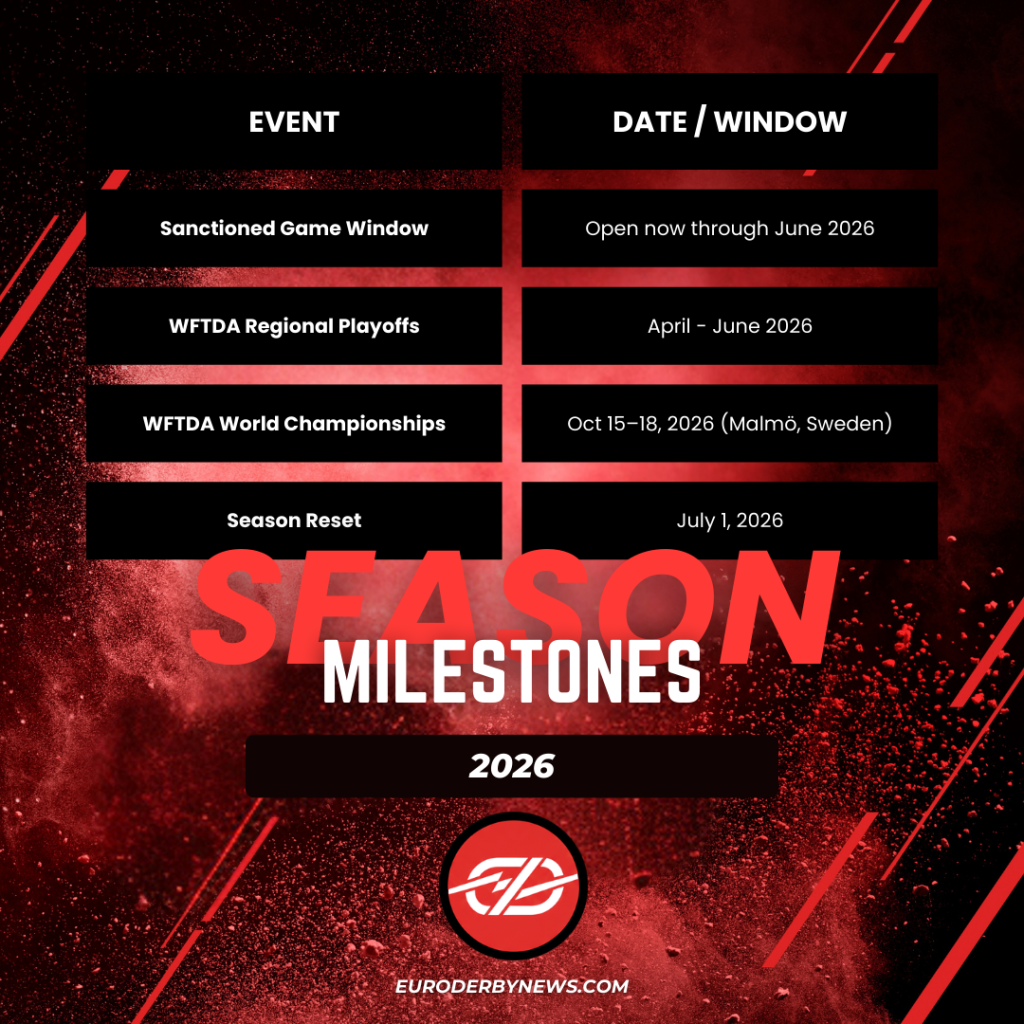
2026 Season Milestones

The season runs in even-numbered years, punctuated by a mandated off-season in December and January to prevent skater burnout.

Road to Regionals: The 2026 Checklist

While the calendar provides the dates, the WFTDA provides the hurdles. Before dreaming of playoffs, teams must tick several boxes. Success means playing not just any games, but the right games at the right time.

[ ] Regional Commitment: Confirm official registration in a geographic region.

[ ] Minimum Game Requirement: Play at least 5 sanctioned games within the window (July 1, 2024 – June 30, 2026).

[ ] The April Cut-off: Complete all qualifying games before the April 1, 2026, ranking deadline.

[ ] Charter Management: Each team’s charter is its official roster. Throughout the regular season, only 8 skaters may compete for both the A and B teams. This overlap restriction decreases to just 3 skaters for the postseason.

While the checklist says five games, competitive Derby often requires more. Top teams aim for 8 to 10 sanctioned games to build a safety net. Rankings can be volatile because the WFTDA uses a Linear Regression algorithm.

Not forgetting the Close Game filter. This means that if a team beats an opponent too heavily (outside a score ratio of 0.25 to 4), that game may not count toward their five-game minimum. Long story short, teams play more to ensure their ranking points are safe from statistical anomalies.

Europe’s Powerhouse National Structures

These technical requirements are only achievable if a team has a stable home. Across Europe, the most successful leagues are those backed by robust national frameworks. These structures provide the logistical and, at times, financial stability that allows teams to focus on the high-level play required to climb the WFTDA ladder.

France: The State-Powered Gold Standard (FFRS)

Managed by the Fédération Française de Roller et Skateboard (FFRS), France provides a benchmark for integrating derby into a national athletic framework.

  • New Divisions: 2026 marks the debut of the Nationale 3 (N3) division to accommodate a massive influx of new leagues.
  • Government Support: Since roller derby is recognised by the Ministry of Sports, clubs in France can apply for the Projet Sportif Fédéral (PSF) grants, awarded for high-level performance activities, development, or equipment purchases.
  • Top Teams: The top 8 teams, including Nothing Toulouse and Nantes, compete in a ‘Final Four’ style playoff.

United Kingdom & Ireland: The Five Nations Giant

The Five Nations Roller Derby Championships is Europe’s largest project. It oversees over 50 teams.

  • The 2026 Split Track: This year, the tournament splits into a WFTDA-Side (for global hunters like the Newcastle Roller Derby) and a Challenge Track for developing leagues.
  • Meritocracy: A ruthless promotion and relegation system means the top and bottom teams rise and fall each year. This keeps the competitive pressure at a constant boil.

Belgium: The “Hosting Hero” (Namur Roller Derby)

Belgium has become a global force, a rise that culminated in its selection to host the 2026 WFTDA Europe Regional Championships in Namur (June 12–14).

  • Regional Funding: The City of Namur and Walloon authorities have provided logistics and venue support. They see the event as a driver of international tourism.

Germany: Administrative Precision (RDD/DRIV)

Germany treats Roller Derby with the same administrative precision as it does Football, through a familiar Bundesliga system, managed by Roller Derby Deutschland (RDD).

  • Olympic Integration: Because Roller Derby in Germany is part of the German Olympic Sports Confederation (DOSB), teams can achieve “club status.” This status allows them to use public sports facilities and receive logistical support, which helps them organise and maintain the teams.
  • Stable Training: This support has allowed leagues like Bear City (Berlin) to maintain stable, multi-decade training homes.

Czech Republic: The Rising East (CRDT)

The Czech Republic has brought its teams together into a high-performance force by working with its National Skate Federation – The Czech Union of Roller Sports (Česká unie kolečkových sportů or CSKB)

  • High Performance: Derby is now included in the federation’s high-performance program, granting national skaters access to the Třebešín training center in Prague.

Together, these national models represent a fundamental shift in how roller derby operates in Europe. By moving away from the isolated ‘DIY’ culture of the past, these countries now use integrated, state-supported athletic programs. This shift builds a foundation to sustain the travel and training demands of a WFTDA competitive cycle.

This stability doesn’t just benefit local skaters; it creates a reliable platform for the high-level, cross-border sanctioned play that defines the rankings. With these frameworks firmly in place, the stage is now set for these nations to collide in the major tournaments and invitationals that will ultimately determine who secures a seat on the plane to Malmö.

The European Scene: Ranking Factories

To understand the competitive environment of European Roller Derby, it is necessary to consider the mechanics of the WFTDA ranking snapshot beyond individual games. During the postseason, tournaments serve as Ranking Factories through which teams secure their standings.

The Math of the Moment

At midnight on April 1, 2026, the WFTDA algorithm takes a permanent snapshot of the regional standings. This isn’t just a monthly update. This is the definitive moment that determines the postseason’s architecture:

  • Playoff Invitations: Only the top-ranked teams in Europe on this day receive an invitation to the WFTDA Europe Regional Championships (Euro Champs) in Namur.
  • Bracket Seeding: The team’s rank on April 1st determines its position in the tournament’s playoff draw, commonly known as “seeding.” Higher-seeded teams generally have a more favourable matchup since they avoid facing top-ranked teams in their first playoff games.

Those 5 Games

A high ranking alone isn’t enough. To be eligible for that April 1st snapshot, a team must have played at least five sanctioned games within the current two-year window (July 1, 2024 – June 30, 2026).

This requirement makes some tournaments special: they act as key opportunities for teams to meet the required number of sanctioned games. For these events, the main goal is not winning a trophy, but playing enough qualifying matches to protect each team’s ranking and eligibility.

Major recurring invitational events include Capitol Clash (Toulouse) and West Track Story (Nantes). Triple-Headers – fixed multi-game events like those in Barcelona, Zurich, and Norfolk let teams play three sanctioned games in a weekend. Themed tournaments like the Skate Around series (Namur) and Passport to Valhalla are the final chance for teams on the bubble to secure their spot before the deadline.

Recency Bias of the Algorithm

As mentioned, the WFTDA algorithm is a linear regression model used to calculate rankings. Basically, while older match results help establish a team’s base ranking, more recent games strongly affect the ranking. This often causes a last-minute rush to play and win important games in the final months before the rankings snapshot.

A single dominant performance at a late-season event like EuroClash (returning in 2026) can theoretically skyrocket a team’s standing just 72 hours before the snapshot, allowing them to leapfrog opponents who stayed home.

For fans and skaters alike, this makes the final twelve weeks of the season a high-speed chase, with the April 1st snapshot marking whether the road continues to the Playoffs or ends for the year.

MRDA Architecture

While the WFTDA landscape is defined by its new two-year regionalised cycle, the Men’s Roller Derby Association (MRDA) operates on a more concentrated, high-velocity model.

Right now, the focus is not on the Road to Champs but on the fast-approaching 2026 Men’s Roller Derby World Cup in Orléans, France. This event represents the pinnacle of the Men’s and Open gender game, shifting the spotlight directly onto European soil.

In MRDA, Europe is no longer a challenger. It is a gatekeeper. With powerhouse leagues in the UK & France, European Men’s and Open-gender Derby has become the most competitive cluster in the world.

MRDA Competitive Engine

Unlike the WFTDA’s two-year eligibility window, the MRDA typically operates on an annual seasonal cycle. This creates a sprint mentality. To be eligible for World Championships, teams must meet strict sanctioning requirements within a tighter timeframe, making every international fixture a strategic calculation.

  • The Sanctioning Threshold: To qualify for a world ranking, MRDA teams must play at least 3 sanctioned games per season. However, to be competitive for a Championship invite, most teams aim for 6 to 10 games to stabilise their algorithm score.
  • Strength of Schedule Factor: The MRDA algorithm heavily rewards teams that play outside their immediate geographic bubble. For European teams, this means some transatlantic diplomacy, hosting North American teams or traveling to the U.S. to ensure their European scores translate accurately to the rankings.

Pillars of European Power

The MRDA architecture in Europe is built on three distinct pillars that allow teams to maintain top rankings without the constant need for expensive overseas travel:

The “Big Three”

The competitive density in Europe is anchored by 5 French and UK teams. Because these five leagues often sit in the World Top 10, games against them carry significant weight, allowing other European teams to climb the rankings while staying within the continent.

National Recognition (The French Model)

Following the WFTDA trend, the French Federation (FFRS) has integrated the Championnat de France Masculin into the national sports framework. This provides MRDA-aligned teams in France with government-backed venues and funding, a luxury their North American counterparts rarely enjoy.

The MERD Movement

The Men’s European Roller Derby (MERD) community acts as an informal yet vital influence, coordinating tournament dates to ensure that ranking weekends don’t overlap and maximising the number of sanctioned officials available.

Strategic Landmarks

For an MRDA team, the calendar is punctuated by Efficiency Weekends, events designed to allow multiple sanctioned games against diverse opponents in 48 hours.

MEC (Men’s European Cup): This is the definitive Algorithm Shakeup for the MRDA side. It is the premier tournament where the top European men’s and open-gender teams (such as Tyne and Fear, Southern Discomfort, and Roller Derby Toulouse) face off. Because it features the highest density of sanctioned MRDA games in the region, it is the primary driver for European seeds in the world MRDA rankings.

The French Nationale 1 Playoffs: While a national tournament, the sheer number of high-ranking MRDA charters in the French top flight makes this a de facto European ranking hub.

MRDA Western/Eastern Qualifiers: Depending on the season’s structure, the MRDA runs Qualifiers rather than the WFTDA’s Regional Championships. For European teams, the goal is to secure a Golden Ticket directly to the World Champs by ranking in the Top 4 of the European cluster.

A Roster Challenge: The Open Gender Edge

A unique aspect of the MRDA architecture is its inclusive gender policy. By allowing all genders to compete, MRDA rosters in Europe often feature a mix of experienced men’s players and top-level non-binary or female-identifying skaters who seek the specific style and challenges of the MRDA game.

However, this can create a strategic roster conflict during WFTDA Championship years. Skaters must often choose between the Road to WFTDA Champs and the Road to MRDA Champs, as the training loads for two elite-level charters are often unsustainable.

North America = Entrepreneurial Independence

While European Roller Derby is increasingly defined by state-integrated architecture, the North American model remains a testament to the sport’s roots in radical independence and grassroots entrepreneurship.

In the U.S. and Canada, the average structure is less a government-backed framework and more a collection of small businesses and skater-owned collectives navigating a private market.

Entrepreneurial Entities (LLCs and 501(c)(3)s)

In North America, starting a league is often likened to launching a small business. Many leagues are incorporated as for-profit LLCs or 501(c)(3) non-profit corporations, managed entirely by the skaters themselves. This “for the skaters, by the skaters” business model allows for total creative and cultural control, free from the red tape of national sports ministries. However, this independence means leagues are responsible for their own survival, relying on member dues, ticket sales, and local sponsorships rather than state grants.

Real Estate Challenges

The most defining physical characteristic of North American Roller Derby is its reliance on private space. Unlike European leagues that often use subsidised municipal halls, North American teams must frequently secure private practice space.

The Warehouse Model: High-level leagues often lease massive industrial warehouses (like Angel City Derby’s 25,000 sq. ft. facility in Los Angeles) to build dedicated Derby spaces.

Vulnerability: This reliance on the private rental market creates a precarious architecture. Rising real estate costs and lease losses are constant threats to league stability, forcing teams to move or fold when commercial spaces are repurposed or become unaffordable.

Developing Talent: Junior Pipeline (JRDA)

While the European model excels at high-performance adult training, North America’s greatest architectural strength is its youth feeder system. The Junior Roller Derby Association (JRDA), established in 2009, has standardised rules and rankings for youth leagues across the continent. This system, often partnered with organisations like the Amateur Athletic Union (AAU), has produced a generation of athletes who have been playing at an elite level since childhood. This provides North American adult leagues with a steady influx of high-IQ, technically superior talent.

Travel Tax

Because of the vast geography of the U.S. and Canada, North American Roller Derby is structured into regional silos (Northeast, South, West). While the WFTDA sets the international standards for rules and rankings, the sheer distance between competitive hubs creates a travel tax. To achieve the high-level sanctioned play required for world rankings, teams must often fund expensive cross-country or international travel, making the climb to the top of the standings a significant financial undertaking for the individual skaters.

Why does any of this matter?

The architecture of Roller Derby is more than an administrative footnote; it is the primary engine that determines who will secure a seat on the plane to a World Championship. In both the WFTDA and MRDA landscapes, the rankings reveal a dual narrative: while the absolute peak of the sport remains a stable elite, the middle ground is a volatile battlefield where regional infrastructure can make or break a team’s season.

WFTDA: Regional Volatility vs. Global Giants

The transition to a two-year competitive cycle has created two distinct tiers of “Top 10” teams:

Global Constants: At the very top of the world rankings (GUR), the hierarchy is remarkably stable. Powerhouses like the Rose City Rollers (Portland), Arch Rival (St. Louis), Victorian Roller Derby League (Australia), and Denver Roller Derby continue to dominate the top slots globally, having turned their long-term stability into a permanent lock on our sport’s peak.

Regional Shuffling: Under the new regional architecture, the regional Top 10 lists are far more dynamic. In Europe, the Ranking Factory effect (where teams play high-density sanctioned weekends) allows leagues to leapfrog each other just before the crucial April 1st snapshot. While Rainy City (Manchester) and Crime City (Malmö) remain European anchors, leagues like Nantes and Toulouse have seen rapid rises due to the state-supported stability of the French (FFRS) model.

MRDA: Efficiency Weekend Shakeups

Unlike the WFTDA’s two-year cycle, the MRDA’s annual sprint results in more frequent turnover in the rankings.

Sprinter Mentality: Because teams must play at least three sanctioned games annually to maintain a ranking, a single Efficiency Weekend can cause seismic shifts in the world standings.

European Dominance: This volatility has benefited Europe immensely. Powerhouses like Roller Derby Toulouse, Tyne and Fear (Newcastle), and Southern Discomfort (London) now frequently occupy half of the World Top 10. This competitive cluster in Europe provides more frequent opportunities for top-tier play than the more geographically dispersed North American MRDA teams.

The Era of Collaborative Excellence

This data paints a clear picture: the “Top 10” is no longer just a measure of a team’s talent, but a reflection of the infrastructure supporting them. The architecture of European Roller Derby is no longer a collection of isolated countries, but a unified bridge to the world stage.

Whether through the state-powered systems of France or the massive collaborative scale of the Five Nations, the continent has moved into a period of stability. These frameworks do more than just organise games; they create a reliable platform for the high-level, cross-border play that now defines the world rankings.

As WFTDA teams barrel toward the April 1st snapshot for the 2026 Europe Regional Championships in Namur and MRDA-aligned skaters prepare for the world stage in Orléans, the machinery of the sport has never been more precise. The coming months will test not just the skaters’ physical endurance, but the administrative foresight of their leagues. In this new landscape, winning on the track is only half the battle; navigating the data, the sanctioning requirements, and the geography is what will ultimately crown the next World Champions.

The echoes of the DIY era are fading in Europe, replaced by the precise rhythm of top-level, structured leagues. From Prague’s training halls to the tracks of Newcastle and Toulouse, the message is undeniable: Europe has stopped dreaming of the world stage and started owning it.

Next Week

Subscribe now via Substack to receive our upcoming 2025 Season Retrospective. We’re breaking down the strategic triumphs, the heart-breaking upsets, and the winners who redefined the rankings. Get the definitive word on European Roller Derby delivered straight to your inbox.